Showing posts with label jungle. Show all posts

Saturday, September 11, 2010

An Expotition

 
Mid-August, I took a brief excursion to Sauraha, a small village on the edge of Chitwan National Park. I stayed at a small resort owned by a friend of Anish’s (he knows everyone) along with the other four volunteers who were living in the house in Bharatpur. The main road is quite short, a few tourist-tat shops with the same little elephant carvings you can find all over Nepal (though I hear they are all made in Kathmandu anyway.) The village itself is home mostly to Tharu people, who have lived in the area long enough to develop a natural immunity to malaria.

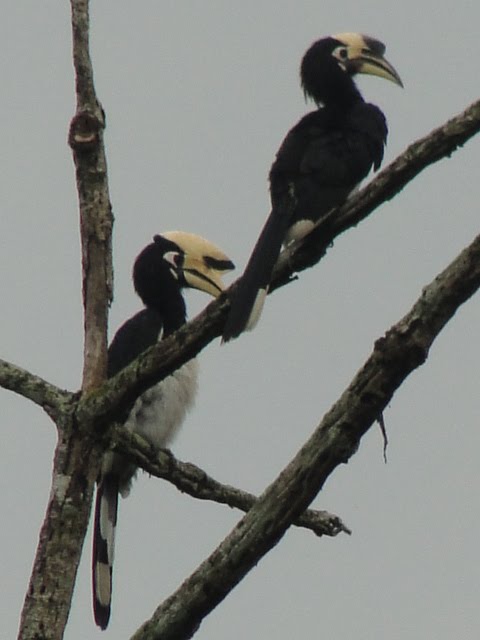
Our package deal included two nights, meals and activities, starting with a little guided afternoon walk around the village (during which I saw some hornbills as well as the only pig I have seen in Nepal), a visit to the elephant barns and, after dinner, a really entertaining Tharu cultural dance program, held at a nearby hall.




At dinner, there was a brief discussion of things we needed to have with us for our jungle activities, namely dark colors, long sleeves and pants, insect repellant, a rain jacket, and shoes you can run in. Many in our party were missing at least one important item, including me. I’d known we’d be going into the jungle on the back of an elephant; I was not aware I would also be going in on foot, asked to keep a sharp eye out for any of the various wild animals which would want to kill me if they knew I was around. So I didn’t have proper shoes.

I hardly slept that night, despite reassuring myself that if people were maimed on these trips with any kind of regularity, they would stop running them. Just a couple of weeks before, the military had declared an end to the long-standing tourist activity of bathing the elephants in the river after safaris because a guy drowned.

In the morning, we followed an early breakfast with a ride downriver in a very straight-sided canoe carved from a log. On either side of us, the water surged and calmed over and over, disturbed by the just-below-the-surface movements of enormous alligators.


Forty-five minutes later, we disembarked on the steep, muddy riverbank and walked into the jungle. Our guide was kind and smiley and thoroughly experienced. Once in the trees, we came to a little clearing and he gave us a quick briefing about the wildlife that lives in the park and what to do in the event that we should encounter any of them. I cinched my sandals uncomfortably tightly to my feet. He also spoke about treading lightly and speaking in low voices, if at all. We continued solemnly into the understory on what one of my companions had been calling our “jungle walk of death” since hearing the description of dangers at the hotel the night before.

I have never been so alert. Our guide paused now and then to point out the claw marks of a tiger or a sloth bear in a tree trunk. The air was very still, so every swish of leaves or snap of a twig in the trees on either side of us caused my eyes to widen like a lemur’s, darting all around. Eventually, we emerged from the green jungle into the dreaded elephant grass. It is meters tall this time of year (hence its name), making it impossible to see if there is an animal mere feet from you at any given point. This can be good or bad. If an animal can hear you, it may charge or attack; on the other hand, you may escape detection by an animal which could see you if the grass were not so high.
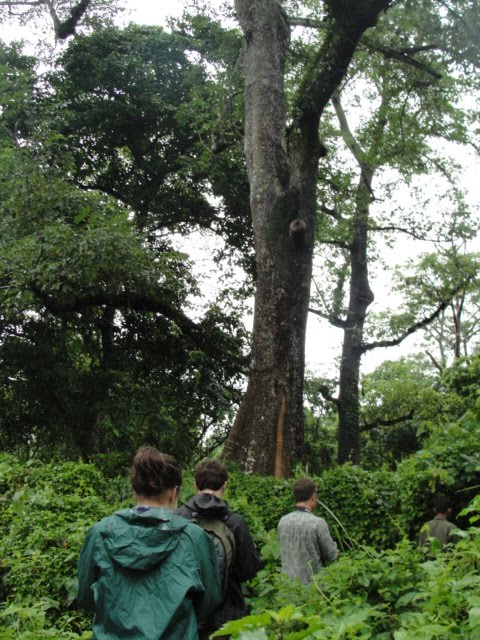


Well, we survived our death walk having seen only a couple of interesting caterpillars, a millipede, and some deer and monkeys that were far enough away to be mostly hidden in the trees. Most everyone got at least one leech on them at some point, as we had plenty of deep puddles to wade through. Oddly enough, though I was the only person wearing sandals, I didn’t get one until the last two minutes of the walk, when we had to wade through knee-deep water, and even that one was only about ¼ inch long.


Relieved and exhausted from too little sleep and a nerve-wracking morning jaunt, we came back to the river bank just across from the village and were ferried across again in dugout canoes.

That afternoon was the part I had been looking forward to since first opening a Nepal travel guide: the elephant trek. Fed and rested, we walked over to the elephant boarding area, climbed some precariously-balanced metal stairs up to the platform, and climbed one at a time into a little wooden basket on top of an elephant. Each person sits, legs dangling, in one corner of the box, with the driver straddling the elephant’s shoulders, his feet in little rope stirrups behind its massive, leathery ears. He had a couple of tools with him, a wooden stick for guiding and a nasty-looking sort of fire poker/gaff, which he said was only used if the elephant got really unruly. I was glad I didn’t have to see that one in action.


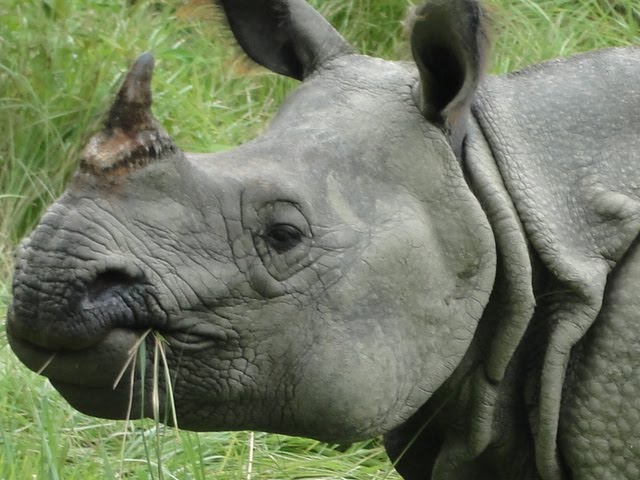
Our trek lasted a couple of hours, during which we saw a peacock, a rhino and her offspring and lots of spotted deer. We also got to ford a couple of sections of river, which was both fun to do and fun to watch. There were several elephants in our group, but apparently in high season they might have 40 out there at once.




The next morning, our final activity was another trip across the river to the elephant breeding center, where we learned about the history of keeping elephants in Nepal and saw lots of little elephant families.


And that was Sauraha.


Tuesday, August 31, 2010

Simple Pleasures

 
The Murry Foundation English School is a sort of boarding school/orphanage serving about 90 kids who are more or less orphaned because at least one parent has been maimed or killed by a wild animal.  Most have aunts and uncles or other family that they go home to at festival time in the autumn, but some have no one at all.  There are a few adults who live there with them--cooks and people who mind their limited livestock--but not at a ratio that gives any of them the kind of attention or support most of us experience growing up.  Also present are a couple of cows and buffalo and a bunch of those lop-eared goats who wander around grazing, climbing anything they can climb and meandering the dining hall to nibble on food scraps, corn husks and table legs.  Besides the school (which also houses their severely overcrowded sleeping quarters,) there are outbuildings for toilets and showers and a large kitchen/dining hall.  From any point on the south side of their land, you can look across a broad field of rice paddies to the edge of the jungle that stretches all the way to India.


Besides midweek national holidays, the only day there is no school is Saturday.  Sometimes I stay home to get things done, but often I ride up to the orphanage just to spend some time with the kids outside of class, to play with them and to talk to the older students whose English is better and whom I don't get to teach during the week.

On rainy Saturdays, a lot of the kids pour into one end of the dining hall and watch bad Indian TV on a station I have heard is owned by Fox.  I think they have some movies and a DVD player too, but they don't have the basic patch cable to use it.  I usually try to bring something with me, like paper and crayons, but often it is the things I have with me all the time that they are most interested in, like sunglasses, an umbrella, or, of course, my camera.  They love taking pictures, and they love having their pictures taken, but there are always a few kids who snatch it away from the less powerful ones when I am not looking, or who weasel their way into four out of every five pictures taken.


Sometimes this job is extremely difficult.  It can be hard to motivate kids who have no parents to push them, to encourage them, to reward them or to discipline them.  It is difficult to teach in an environment where materials are so lacking and the things they do have are grossly inadequate.  I know they have more here than a lot of kids have--a roof over their heads, two meals a day, an education--but it is still so hard to see them go without.

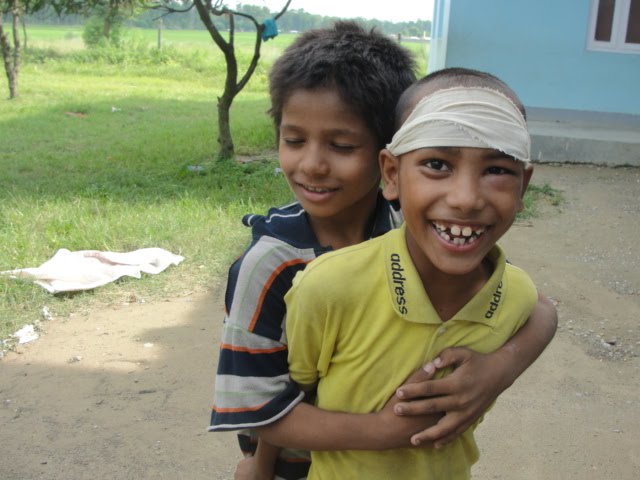
At the end of the day, the most I can do is to give them my best effort in class and my time and attention out of class, where I can play chase games and tickle monster with the little ones and give them piggy-back rides and just scoop them up so they can sit on a lap and be bounced a bit.  It is amazing and endlessly inspiring to me how their little faces light up from these simple pleasures, their laughter echoing, amplified in a cavernous empty room.


Welcome to the Jungle

 
It has been nearly a month since I arrived in Bharatpur, in the southern-central part of Nepal.  When I was planning this trip, most people I told were under the impression I would be huddled in a thatch-roof hut in the Himalayas, scratching verb conjugations into blocks of ice for the benefit of orphaned Sherpa children.  The reality is quite the opposite.  As many people know, Nepal contains at least one slope of 8 of the 10 highest mountains in the world, but at its southern border, it's only a few hundred feet above sea level.  Here, it is a hot, humid, landlocked jungle.  Even when the monsoon brings days of rain, it is still warm.  I haven't worn socks and shoes in weeks.  Every day I must find a balance between the need to stay hydrated and the possibility of getting stuck in a situation where there is no place to relieve myself.

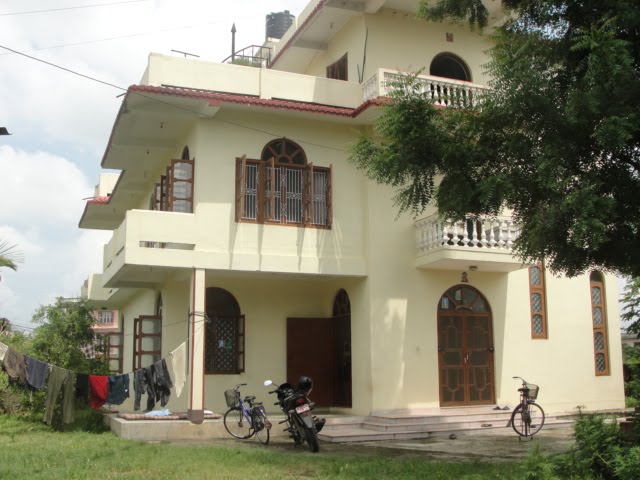
I am living with Anish (the director of Volnepal,) his sister, her 3-year-old son, and an ever-changing mix of other foreign volunteers on the ground floor of this lovely house. 
Every Sunday through Friday and some Saturdays, I ride a very upright, Indian-style bicycle about 15 minutes to the Murry Foundation English School.  I ride past homes varying from tiny huts with no plumbing or electricity to larger brick houses with small TVs flickering in the windows and motorcycles parked outside.  I ride past water buffalo and floppy-eared goats with knobby knees lazing in the shade or munching on whatever greenery is within their reach.  I ride past enormous rice paddies that whisper shhhhh when a light breeze finds them, past uniformed children who grin and shout, "Hi-Hello-How-are-you-I-am-fine-thank-you!" and men who just stare.  The women stare, too, but they are much more likely to return a smile.


Once at school, I help with homework and play word games until it is time for the kids to eat their first meal at 9:00, after which I teach English to classes 1, 2 and 3 (ages 5 to about 11.)  My favorite parts are when I can involve everyone, playing a game or getting them all working on a project.  The kids are mostly great--more about them in the next post. 


If you are curious about VolNepal, the Nepali NGO through which I am volunteering, you can see all their projects at volnepal.org.